Overview
A septal perforation is an opening through the wall between the nasal passages. Small perforations may whistle; larger or more anterior defects can cause crusting, bleeding, blockage or structural weakening.
Symptoms do not always match size, and not every perforation requires surgery. The cause must be evaluated before repair is considered.
Potential causes
- Prior septoplasty or nasal surgery
- Trauma or cautery
- Intranasal drug exposure
- Chronic manipulation
- Autoimmune or inflammatory disease
- Infection
- Tumor, rarely

Living with nasal septal perforation? The next step is a quiet, unhurried conversation.
How evaluation should work
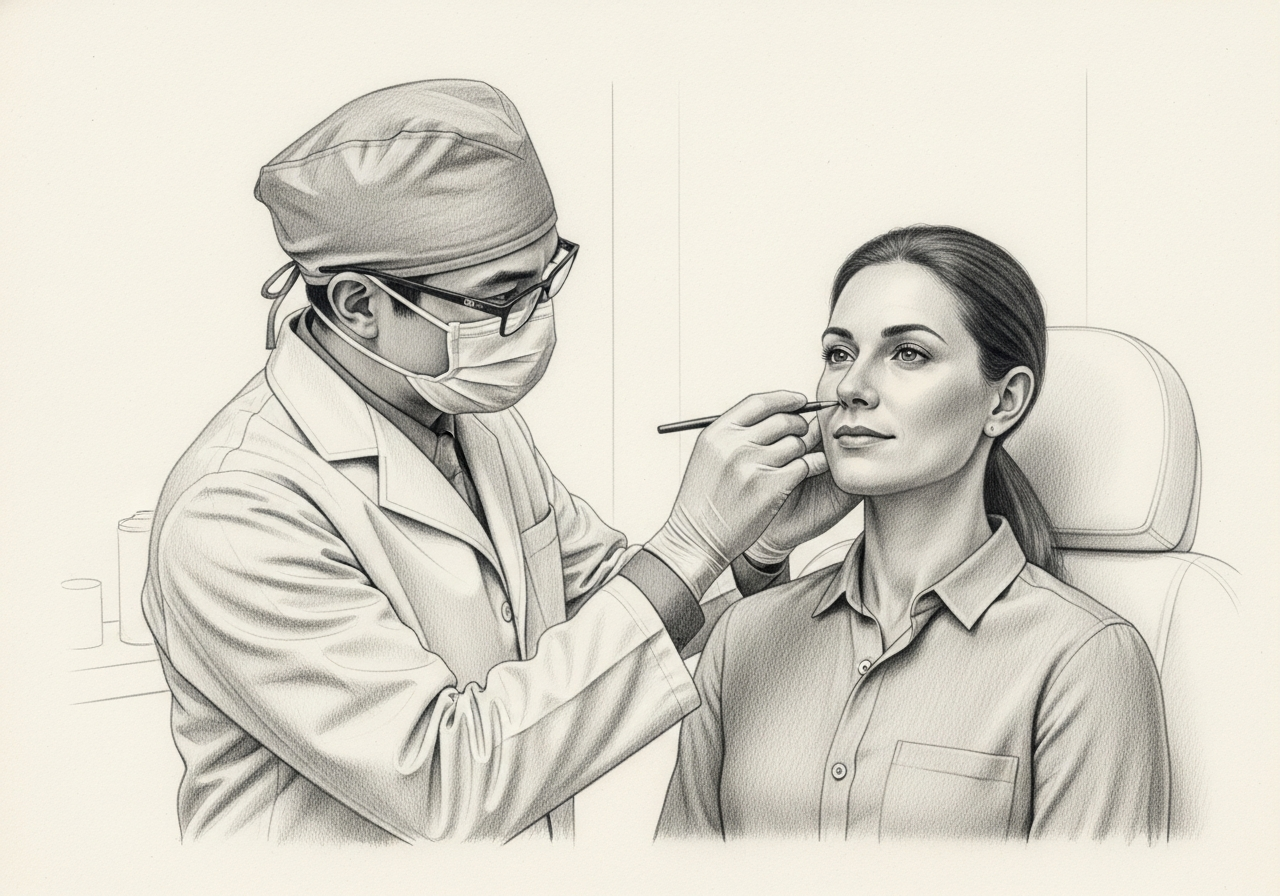
Evaluation includes size, location, edge quality, remaining support and health of the surrounding lining. The clinician should ask about prior operations and exposures and may recommend laboratory testing or biopsy when the cause is unclear.
Any active inflammation, infection or ongoing exposure should be treated before reconstruction.
Treatment considerations
Repair is technically demanding because both sides of the lining and a supporting layer must heal. The approach depends on size, location, available tissue and prior surgery. Candidacy and outcomes vary substantially.

Recovery and follow-up
Moisture and gentle care remain important even after repair.
Splints may stay in place for a surgeon-defined period, and follow-up checks how the closure is healing.
Risks, limits and safety
- Persistent or recurrent perforation
- Bleeding, infection or scar tissue
- Obstruction or contour change
- Need for grafts from another site
- Failure if the underlying cause remains active
Individual risk depends on anatomy, prior treatment, disease severity and overall health, and an in-person consent discussion remains essential. Urgent symptoms should be directed to emergency care rather than an online consultation form.
Suggested next step
A consultation should focus on confirming the diagnosis, reviewing prior treatment and imaging, discussing reasonable alternatives and defining what improvement is realistic. Patients with severe breathing difficulty, uncontrolled bleeding, sudden vision change, neurologic symptoms, fever with neck stiffness, or another emergency should seek urgent medical care.
Medical review
This page is a patient-education resource reviewed by the responsible Norelle ENT clinician before publication. It does not replace an in-person evaluation. If symptoms are severe or rapidly worsening, seek immediate medical care.
From the Patient Gallery
Before and After Septal Perforation Repair
Endoscopic documentation of a septal perforation repair from the Manhattan practice, published with written consent on file. The before view shows the perforation through the septum; the after view shows the repaired septum with the defect closed. Individual results vary with perforation size, location, and tissue quality; this case is representative, not predictive.
View All Nose CasesPre- and post-operative comparison · Written consent on file · Individual results vary
Specialists who treat nasal septal perforation

Dr. Moustafa Mourad
MD, FACS
Double Board-Certified Head & Neck and Facial Plastic & Reconstructive Surgeon
Dr. Moustafa Mourad is a double board-certified head and neck and facial plastic and reconstructive surgeon who cares for the full range of cosmetic and complex conditions affecting the face, head, and neck.
- Facial plastic and reconstructive surgery
- Head and neck cancer surgery
- Microvascular free-flap reconstruction
- Facial trauma and reconstruction
Also caring for this area




Not sure who to see? Our patient coordination team can help match you with the right specialist.
(212) 444-8006Frequently Asked Questions
No. Mild symptoms may be managed with moisture and protection.
Some can, but complexity and likelihood of closure vary with tissue and cause.
It is a removable device that covers the opening; it does not biologically close it.
Ongoing inflammation, exposure or trauma can prevent healing.
Clinical References
These independent resources from medical and professional organizations offer further reading. They are provided for general education and do not replace a consultation with a clinician.
Related Procedures

1 of 3 · Nasal Septal Perforation Surgery

Request a consultation for nasal septal perforation
Schedule an evaluation with our team to review your symptoms and the appropriate next steps.