

About the Procedure
A neck lift is a surgical procedure that improves the contour of the neck and the line of the jaw by treating the specific tissues that age there: the skin, the fat above and below the platysma muscle, and the platysma itself. The neck is one of the first areas to show aging, and it changes in several ways at once. Skin loosens and loses elasticity; fat can accumulate or descend beneath the chin; the submandibular salivary glands and other deeper structures may become more prominent; and the platysma — a broad, thin sheet of muscle that spans the front of the neck — can separate down the midline into visible vertical bands and lose its supporting tone. The combined effect is loss of the sharp angle between the chin and neck, fullness or a "double chin" appearance, and vertical cords or loose skin.
A neck lift is designed to address these problems together. Depending on what the evaluation finds, it may involve tightening and repositioning the platysma (a step called platysmaplasty), removing or repositioning fat, and redraping and trimming loose skin to restore a cleaner jawline and a more defined neck angle. Not every neck needs every step; a younger patient with isolated fullness and good skin tone may need only fat treatment, while an older patient with banding and loose skin needs muscle and skin work as well.
At Norelle Health in New York City, the neck is evaluated as part of the lower face rather than in isolation, because the two age together and a result limited to the neck can look out of balance with the jawline above it. The consultation identifies which tissues are responsible for the appearance the patient wants to change, and matches the procedure — and whether to combine it with a facelift — to the individual anatomy and goals.
Why the neck changes with age
Several distinct changes combine to produce the aging neck, and identifying which ones are present in a given patient is the key to planning.
- Skin laxity. Skin loses elasticity and collagen over time, sun exposure accelerates this, and loose skin no longer drapes smoothly over the neck.
- Fat changes. Fat can accumulate beneath the chin and along the neck (sometimes called a "double chin"), and it sits in two layers — above the platysma muscle and beneath it — each treated differently.
- Platysma banding. The platysma muscle can separate down the middle of the neck, and its edges become visible as two vertical "cords," especially when speaking or tensing the neck. Loss of the muscle's tone also blunts the neck angle.
- Deeper structures. With loss of overlying support, the submandibular glands or the muscles beneath can become more apparent, which influences how much improvement skin and muscle work alone can achieve.
Because these factors vary from person to person, two patients who both want a "better neck" may need quite different operations. A genetically full neck in a young person is a different problem from a lax, banded neck in an older person, even though both involve the same region.
Considering neck lift? The next step is a quiet, unhurried conversation.
What a neck lift addresses
A neck lift is directed at the contour problems of the neck and the adjacent jawline:
- Loss of the chin–neck angle, restoring a more defined separation between the jaw and the neck.
- Fullness or a "double chin" from excess fat above or below the platysma.
- Platysmal banding — the vertical cords seen in the front of the neck — by tightening and rejoining the muscle in the midline.
- Loose, hanging neck skin and early jowling at the jawline, by redraping and conservatively trimming skin.
It does not change skin texture or surface aging, and it does not by itself lift the midface or cheeks. When the lower face has also descended, a neck lift is frequently combined with a facelift so that the jawline and neck are corrected together; a neck lift performed alone can look unbalanced if the jowls above it are left untreated. The right scope is determined by examination, not by a fixed formula.
How the procedure is performed
The components of a neck lift are tailored to the anatomy, and not every patient needs all of them.
Incisions. A small incision is commonly made beneath the chin to reach the fat and the platysma muscle in the midline. When skin needs to be redraped, additional incisions are placed around the ears — beginning near the earlobe and continuing behind the ear into the hairline — so that loose skin can be lifted and trimmed inconspicuously.
Fat treatment. Excess fat above the platysma may be removed with liposuction or direct excision; fat beneath the muscle, when contributing to fullness, is addressed under direct vision through the chin incision.
Platysmaplasty. The separated edges of the platysma muscle are stitched together in the midline and, when needed, tightened toward the sides. This recreates a smooth muscular sling across the front of the neck, improving the neck angle and reducing banding.
Skin redraping. When loose skin is part of the problem, it is redraped over the improved contour and the excess is conservatively removed through the incisions around the ears.
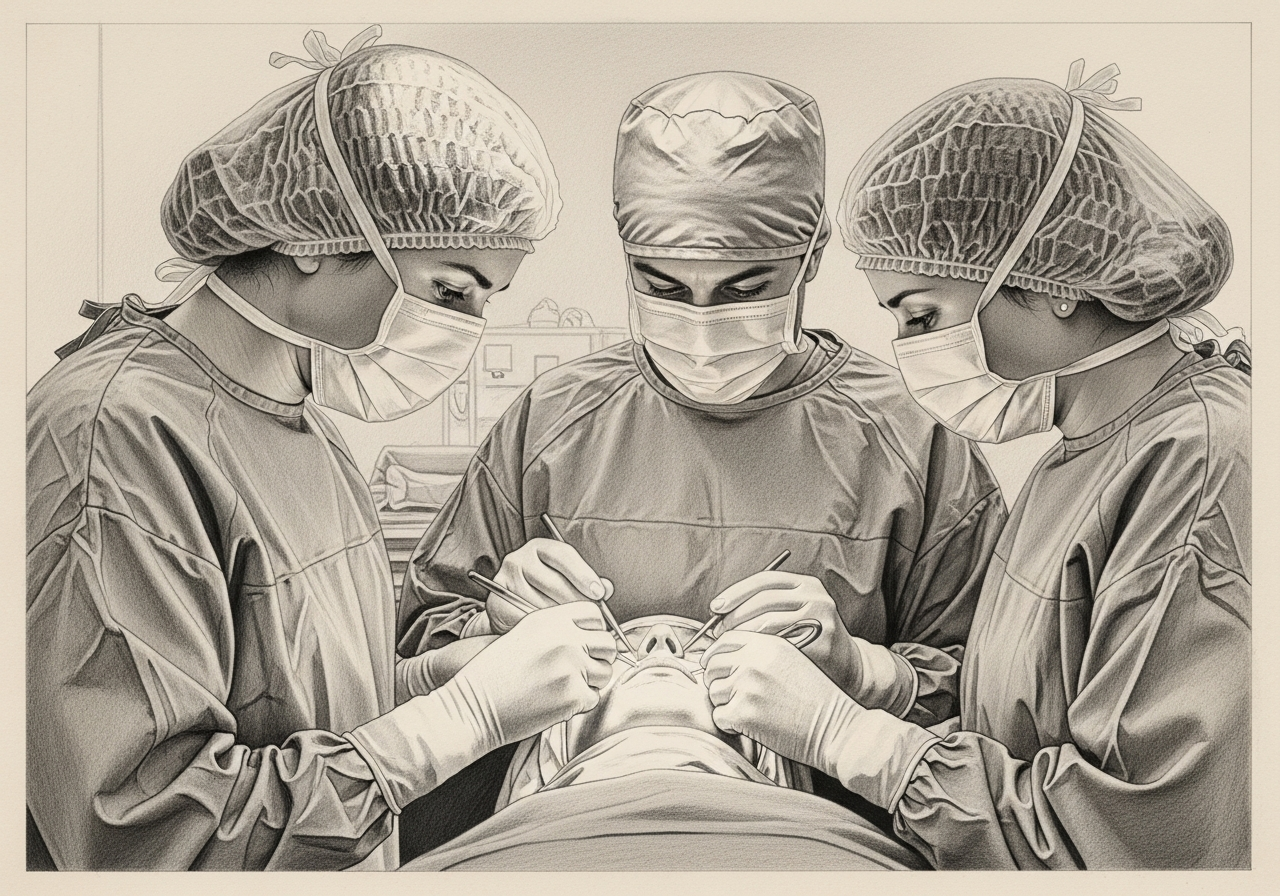
Anesthesia and setting. A neck lift is performed under general anesthesia or sedation, commonly as a same-day or short-stay procedure. A small drain is sometimes placed, and a supportive dressing or garment is often used to help the tissues conform to the new contour during early healing.
Neck lift, facelift, and limited procedures
Several procedures address the neck and jawline, and they are not interchangeable.
- Neck lift treats the neck — fat, platysma, and skin — and the immediately adjacent jawline.
- Facelift treats the descended cheeks and jowls of the lower face. Because the neck and lower face age together, the two are often combined; deciding between a neck lift alone and a combined lift depends on whether the jowls and midface also need attention.
- Submental liposuction alone can be appropriate for a younger patient whose only problem is excess fat with good skin tone and no banding. It does nothing for loose skin or muscle bands, so it is not a substitute for a neck lift when those are present.
- Isolated platysmaplasty addresses banding but not skin excess or fat.
Choosing the least extensive procedure that will actually meet the goal is part of an honest plan. Offering a limited procedure to a patient whose anatomy needs more will not produce the result they want, and recommending more than is necessary is equally inappropriate.
Risks and important considerations
A neck lift is surgery, and an informed decision means understanding the risks:
- Hematoma (a collection of blood under the skin), among the more common early issues, which may need drainage.
- Injury to nerves of the neck and lower face, including the nerve branch that controls part of the lower lip movement, which can cause temporary or, uncommonly, lasting asymmetry; and temporary numbness of the neck skin.
- Skin healing problems, with markedly higher risk in smokers.
- Contour irregularities, such as residual fullness, depressions, or visible edges, which can sometimes require revision.
- Infection and scarring, the latter usually well concealed but occasionally noticeable.
- Recurrence over time, since a neck lift does not halt aging; the neck continues to age naturally afterward.
- Anesthesia-related risks, discussed separately as part of consent.
The presence of prominent submandibular glands or a low-lying position of certain structures can limit how much improvement is achievable, and this is discussed honestly during evaluation. No specific result can be guaranteed.
Nonsurgical options and their limits
Nonsurgical treatments exist for the neck, and they suit specific, limited problems.
- Injectable treatments that reduce a small pocket of fat beneath the chin can help selected patients with modest, isolated fullness and good skin tone, but they do not treat loose skin or muscle banding and may require multiple sessions.
- Energy-based skin tightening can produce modest improvement in mild, early skin laxity but does not correct established loose skin, fat, or platysmal bands.
- Neuromodulator injections can soften the appearance of platysmal bands temporarily in some patients but do not address skin or fat and wear off over months.
These options can be reasonable for early or limited changes and for patients not ready for surgery. When the neck has loose skin, significant fat, and muscle banding together, however, a surgical neck lift is what addresses all three; nonsurgical measures cannot reproduce that result. A candid evaluation includes saying when a nonsurgical route is and is not likely to meet the goal.
Common misconceptions about neck rejuvenation
Because the neck is a common concern, several misunderstandings shape what people expect, and addressing them is part of an honest evaluation.
"Liposuction alone will fix my neck." Removing fat helps only when excess fat is the main problem and the skin has enough elasticity to redrape over the improved contour. When loose skin or platysmal muscle bands are present, liposuction does not correct them, and in a neck with poor skin tone it can even make laxity more apparent. The right procedure depends on which of fat, muscle, and skin are involved.
"A device or cream can replace surgery." Energy-based skin-tightening devices can produce modest improvement in mild, early laxity, and some injectable treatments can reduce a small, isolated pocket of fat. These have a genuine but limited role. They do not reproduce the result of surgery when loose skin, significant fat, and muscle banding occur together, and topical products do not tighten the neck.
"One operation will stop my neck from aging." A neck lift improves contour at a point in time, but it does not halt the aging process. The neck continues to change afterward, and how long the improvement lasts varies with skin quality, anatomy, and lifestyle. The procedure is more accurately understood as setting the appearance back than as a permanent fix.
"The neck can be treated in isolation from the jawline." The neck and the lower face age together. Correcting the neck while leaving descended jowls above it untreated can look unbalanced. This is why the evaluation considers the jawline and lower face, and why a neck lift is often combined with a facelift when both have changed.
"A fuller neck is always due to fat." Fullness under the chin can come from fat above the muscle, fat beneath it, lax or banded platysma, or prominent deeper structures such as the submandibular glands. These are treated differently, and some — such as the position of the glands — limit how much improvement is achievable. Identifying the actual cause is what allows an accurate plan and realistic expectations.
Clearing up these points before surgery helps align the plan with what the procedure can genuinely deliver for a particular neck.
Specialists who perform neck lift

Dr. Moustafa Mourad
MD, FACS
Double Board-Certified Head & Neck and Facial Plastic & Reconstructive Surgeon
Dr. Moustafa Mourad is a double board-certified head and neck and facial plastic and reconstructive surgeon who cares for the full range of cosmetic and complex conditions affecting the face, head, and neck.
- Facial plastic and reconstructive surgery
- Head and neck cancer surgery
- Microvascular free-flap reconstruction
- Facial trauma and reconstruction
Also caring for this area



Not sure who to see? Our patient coordination team can help match you with the right specialist.
(212) 444-8006Frequently Asked Questions
A neck lift addresses the contour problems of the neck and adjacent jawline: loss of the chin–neck angle, fullness or a 'double chin' from excess fat, vertical platysmal muscle bands, and loose neck skin. Depending on your anatomy it may involve fat removal, tightening of the platysma muscle, and redraping of skin. It does not change skin texture or lift the cheeks.
It depends on whether the lower face — the cheeks and jowls — has also descended. Because the neck and lower face age together, the two are often combined so the jawline and neck are balanced. A neck lift alone can look out of balance if jowls above it are left untreated. The right scope is determined by examination of your specific anatomy.
Submental liposuction alone can be appropriate for a younger patient whose only issue is excess fat with good skin tone and no muscle banding. It does not treat loose skin or platysmal bands, so when those are present it is not a substitute for a neck lift. Evaluation determines which problems you actually have.
Those bands are the edges of the platysma, a thin sheet of muscle across the front of the neck that can separate down the midline with age. When its edges become visible they appear as two vertical cords. A neck lift can rejoin and tighten the muscle in the midline (platysmaplasty) to reduce the banding and improve the neck angle.
Incisions are placed to be inconspicuous — commonly a small one beneath the chin and, when skin is redraped, incisions around and behind the ears into the hairline. Scars usually heal to fine, well-concealed lines but can occasionally become noticeable, and they take many months to mature and fade. Your surgeon will discuss placement and care.
Swelling and bruising are most pronounced in the first week, often with a supportive garment. Many patients return to non-strenuous routines within about two to three weeks, with strenuous activity restricted for several weeks. Numbness and firmness improve over the following months, and the final contour settles over several months to a year.
Yes. Prominent submandibular salivary glands or the position of deeper neck structures can limit how much improvement skin and muscle work alone can achieve. An honest evaluation includes discussing these limits so your expectations match what the surgery can realistically deliver for your anatomy.
A neck lift improves contour but does not stop aging, so the neck continues to age naturally afterward. Many patients enjoy a long-lasting improvement, but durability varies with skin quality, anatomy, and lifestyle. It is more accurately thought of as setting the appearance back rather than permanently freezing it.
For early or limited changes — modest isolated fat with good skin tone, or mild laxity — nonsurgical options such as fat-reducing injections, energy-based tightening, or temporary muscle-relaxing injections may help. They cannot correct established loose skin, significant fat, and muscle banding together, which is what a surgical neck lift addresses. Your evaluation will clarify which path fits your goals.
A small drain is sometimes placed to remove fluid that can collect under the skin in the first day or two, and it is usually removed at an early follow-up visit; not every neck lift requires one. A supportive dressing or garment is commonly worn during early healing to help the tissues conform to the new contour, often more at night, for a period your surgeon will specify. These measures support healing and the settling of the new neck contour.
Light walking is usually encouraged early to support circulation, but strenuous exercise, heavy lifting, and straining are typically restricted for several weeks to protect the healing tissues and reduce the risk of bleeding under the skin. Most patients return to non-strenuous routines within about two to three weeks. Your surgeon will give specific timelines based on your procedure, any combined facelift, and how your healing progresses, and it is advisable to resume vigorous activity gradually rather than all at once.
Clinical References
These independent resources from medical and professional organizations offer further reading. They are provided for general education and do not replace a consultation with a clinician.
Related Conditions


Request a consultation about neck lift
Schedule a consultation with our team to discuss whether this procedure is the right option for you.