
Overview
Throat cancer refers to cancers of the pharynx, the passage behind the nose and mouth that connects to the voice box and esophagus. It includes cancers of the area behind the mouth, such as the tonsils and base of the tongue, as well as higher and lower parts of the throat. Symptoms can be subtle, which is why persistent changes deserve evaluation.
Common signs include a neck lump, a persistent sore throat, difficulty swallowing, one-sided ear pain, or a voice change. Tobacco and alcohol use are recognized risk factors, and certain types of HPV are associated with cancers of the tonsil and base of the tongue.
Norelle ENT evaluates throat cancer with endoscopic examination, biopsy, and imaging, and coordinates care across radiology, pathology, and medical and radiation oncology. Treatment planning focuses on accurate diagnosis and staging and on preserving swallowing, voice, and breathing whenever possible.
How we approach the decision
Throat cancer is not one diagnosis. The first job is to identify the precise site, because cancers of the tonsil, tongue base, hypopharynx, nasopharynx, and larynx behave differently and may require very different treatment. The decisions this care is meant to help you understand are:
- What exact anatomic site is involved, and has it been documented with endoscopy, imaging, and pathology?
- Is the tumor HPV-related, EBV-associated, or another histologic type that changes staging or planning?
- Can treatment preserve swallowing, voice, and airway function without compromising disease control?

Living with throat cancer? The next step is a quiet, unhurried conversation.
What happens next
Evaluation usually follows a clear sequence:
- A targeted history and complete head and neck examination.
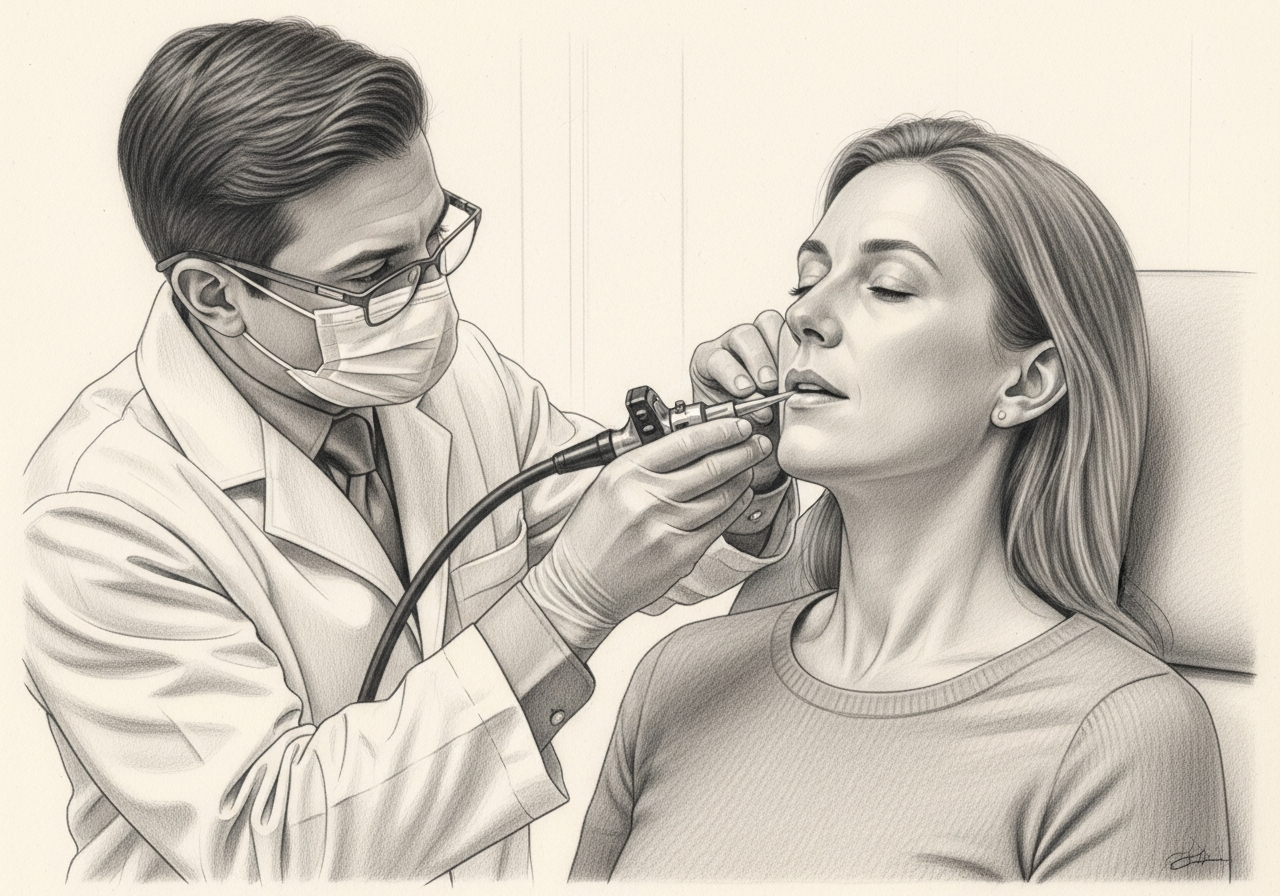
- Flexible laryngoscopy to inspect the nose, pharynx, tongue base, tonsils, hypopharynx, and larynx.
- Biopsy or fine needle aspiration with site-appropriate HPV, p16, EBV, or other testing, which often distinguishes HPV-related oropharyngeal cancer, tonsil cancer, and base of tongue cancer from larynx cancer.
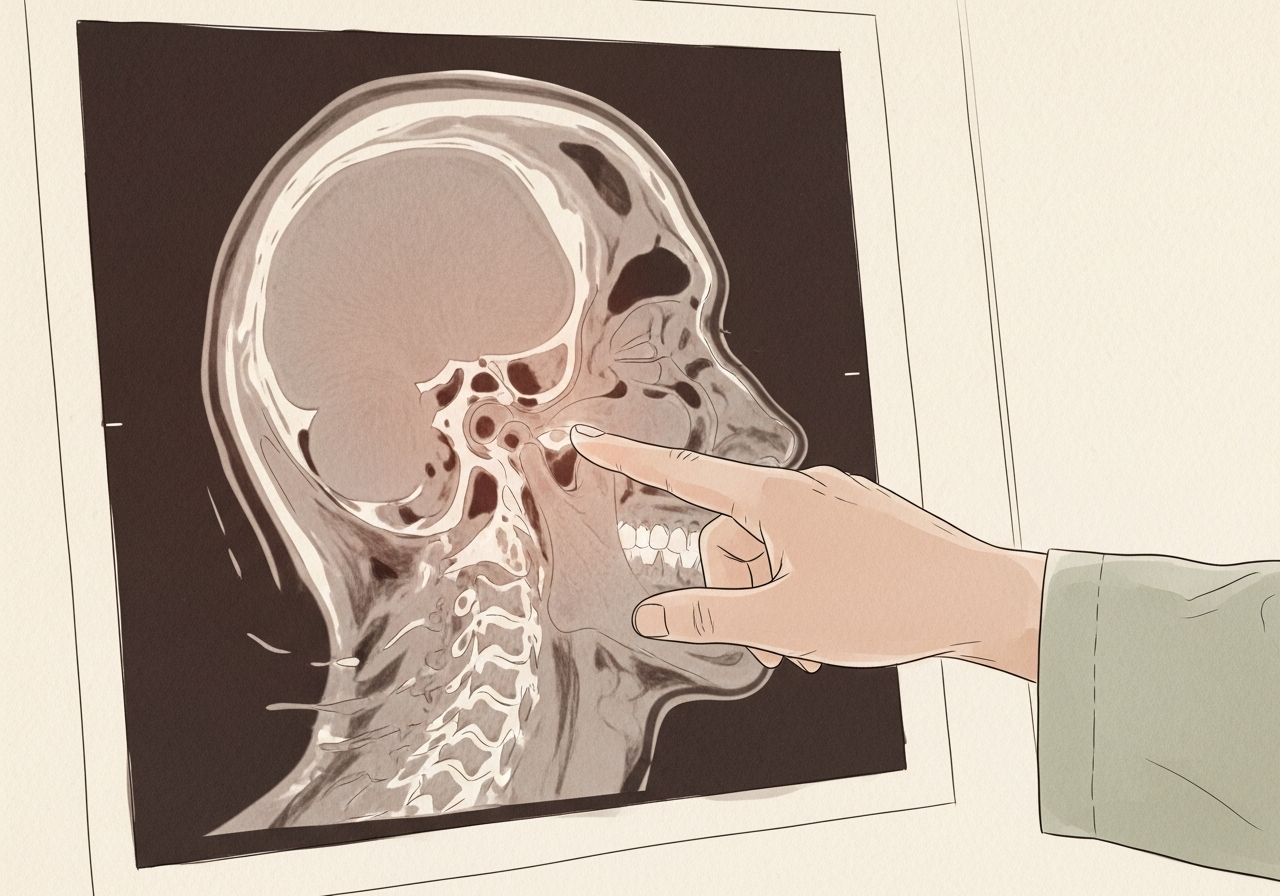
- Cross-sectional imaging and, when appropriate, PET-based staging.
- A treatment comparison that explicitly addresses speech, swallowing, airway, and nutrition, including how a tumor may cause difficulty swallowing and how rehabilitation supports recovery.
Symptoms and warning signs
Throat cancer can present as a neck lump, a persistent sore throat, difficulty or pain with swallowing, a voice change, one-sided ear pain, or a sensation of something stuck in the throat.
A neck lump in an adult and symptoms that persist for two weeks or longer should be evaluated. HPV-related throat cancers sometimes appear first as a painless neck lump.
Causes and risk factors
Recognized risk factors include tobacco use in any form and heavy alcohol use. Certain types of HPV are associated with cancers of the tonsil and base of the tongue, and HPV-related throat cancer can occur in people without a tobacco history.
A clinician will ask about tobacco, alcohol, and HPV-related risk. Having a risk factor does not confirm cancer, and the diagnosis is established by examination and biopsy.
How it is diagnosed
Diagnosis combines examination, tissue sampling, and imaging:
- A head and neck examination with flexible endoscopy
- Biopsy or fine needle aspiration of a neck node
- HPV testing of the tumor when relevant
- CT, MRI, or PET imaging to define the tumor and check for spread
These steps establish the diagnosis and stage, which guide treatment.
Treatment options
Treatment depends on the location and stage of the cancer and may involve radiation therapy, surgery, chemotherapy, or a combination. Some throat cancers are treated with radiation, sometimes combined with chemotherapy, while selected tumors are treated with transoral surgery.
When surgery is used, it may include treatment of neck lymph nodes, and speech and swallowing rehabilitation support recovery. Care is coordinated through a multidisciplinary team that weighs cancer control with preserving function.

When to seek urgent care
Use these categories to guide timing:
- Emergency, meaning call 911 or go to the nearest emergency department: difficulty breathing, coughing or vomiting blood, an inability to swallow liquids or saliva, or severe dehydration.
- Same-day or urgent evaluation: rapidly worsening symptoms.
- Routine specialist evaluation: a neck lump, a persistent sore throat, difficulty swallowing, a lasting voice change, or one-sided ear pain that does not resolve.
The online consultation form is for routine scheduling and is not an emergency service.
Clinical perspective
Our head and neck surgeons emphasize that the precise anatomic site drives treatment. Cancers of the oropharynx, hypopharynx, nasopharynx, and larynx are staged and treated differently, and HPV-related oropharyngeal cancer behaves differently from cancers linked mainly to tobacco and alcohol.
For many throat cancers, radiation, sometimes combined with chemotherapy, and transoral surgery are both options, and the choice depends on the site, stage, and the expected effect on swallowing, voice, and the airway. When surgery is used, treatment of neck lymph nodes is often part of the plan, and swallowing assessment and nutrition planning are considered early rather than only after a problem develops.
What commonly changes the recommendation is the confirmed primary site, HPV or other biomarker results, and staging imaging, along with what the patient values in function. Candidacy is determined individually after specialist review.
What to bring to your consultation
Bringing the right records makes a consultation more efficient. Helpful items include:
- Prior imaging and the written reports
- Pathology or biopsy results when available
- Recent laboratory results
- Treatment notes and operative reports from any prior care
- A current medication list
- The specific decision you want the consultation to answer
For a second opinion, the pathology report and slides and any imaging files are especially useful. Request a consultation for a focused review of the diagnosis, the available options, the likely tradeoffs, and the steps needed before treatment.
Medical review
This page is a patient-education resource reviewed by the responsible Norelle ENT clinician before publication. It does not replace an in-person evaluation. If symptoms are severe or rapidly worsening, seek immediate medical care.
Specialists who treat throat cancer

Dr. Moustafa Mourad
MD, FACS
Double Board-Certified Head & Neck and Facial Plastic & Reconstructive Surgeon
Dr. Moustafa Mourad is a double board-certified head and neck and facial plastic and reconstructive surgeon who cares for the full range of cosmetic and complex conditions affecting the face, head, and neck.
- Facial plastic and reconstructive surgery
- Head and neck cancer surgery
- Microvascular free-flap reconstruction
- Facial trauma and reconstruction
Also caring for this area


Not sure who to see? Our patient coordination team can help match you with the right specialist.
(212) 444-8006Norelle Academic Work
Research by Our Physicians
Selected scholarly work related to this topic.

Evaluating organ preservation outcome as treatment endpoint for T1aN0 glottic cancer
The Laryngoscope
Postoperative Management After Tracheostomy and Laryngectomy: Improving Nursing Knowledge With Bedside Posters
OTO Open
Treatment of locoregionally advanced laryngeal cancer: Institutional outcomes of primary surgery compared to primary radiation
Radiotherapy and Oncology
Organ preservation with external beam radiotherapy and systemic therapy in patients with locoregionally advanced laryngeal cancer: An institutional experience
International Journal of Radiation Oncology, Biology, Physics
Geographic Trends in Management of Early-Stage Laryngeal Cancer
Laryngoscope
Management of the Thyroid Gland during Total Laryngectomy in Patients with Laryngeal Squamous Cell Carcinoma
Laryngoscope
Citation details link to the original PubMed, DOI, journal, or publisher record.
Explore all Norelle research on this topicFrequently Asked Questions
It is cancer of the pharynx, the passage behind the nose and mouth, including the tonsils and base of the tongue. Because it affects swallowing, voice, and breathing, care focuses on accurate diagnosis and preserving function.
Signs include a neck lump, a persistent sore throat, difficulty swallowing, a voice change, and one-sided ear pain. HPV-related throat cancer sometimes first appears as a painless neck lump.
Certain types of HPV are associated with cancers of the tonsil and base of the tongue, and these can occur in people without a tobacco history. HPV testing of the tumor is performed when relevant.
Diagnosis combines a head and neck examination with endoscopy, a biopsy to confirm the diagnosis, and imaging such as CT, MRI, or PET to define the tumor and check for spread.
Treatment depends on the location and stage and may involve radiation, surgery, or chemotherapy, often in combination. The plan aims to balance cancer control with swallowing, voice, and breathing function.
Care is planned to preserve function whenever possible, using approaches such as radiation or transoral surgery and supporting recovery with speech and swallowing rehabilitation.
Yes, second opinions are reasonable for cancer decisions. Bringing prior imaging, biopsy results, and reports helps make the review thorough and efficient.
The phrase may refer to cancers of the oropharynx, hypopharynx, nasopharynx, or larynx. The exact site should be confirmed because staging and treatment differ.
Yes. Some throat tumors cause referred pain to one ear even when the ear examination is normal. Persistent one-sided ear pain with throat symptoms or a neck mass deserves evaluation.
No. HPV is strongly associated with many oropharyngeal cancers, especially tonsil and base-of-tongue cancers, but not all throat or laryngeal cancers.
A thin flexible scope can usually examine the nasal passages, throat, tongue base, voice box, and surrounding structures. Biopsy is a separate step when tissue is needed.
It can. The risk depends on the tumor site and treatment. Swallowing assessment, nutrition planning, and therapy should be considered early rather than only after a problem develops.
Clinical References
These independent resources from medical and professional organizations offer further reading. They are provided for general education and do not replace a consultation with a clinician.
Related Procedures

Related Conditions

Request a consultation for throat cancer
Schedule an evaluation with our team to review your symptoms and the appropriate next steps.